British English vs American English: A Practical Spelling Guide
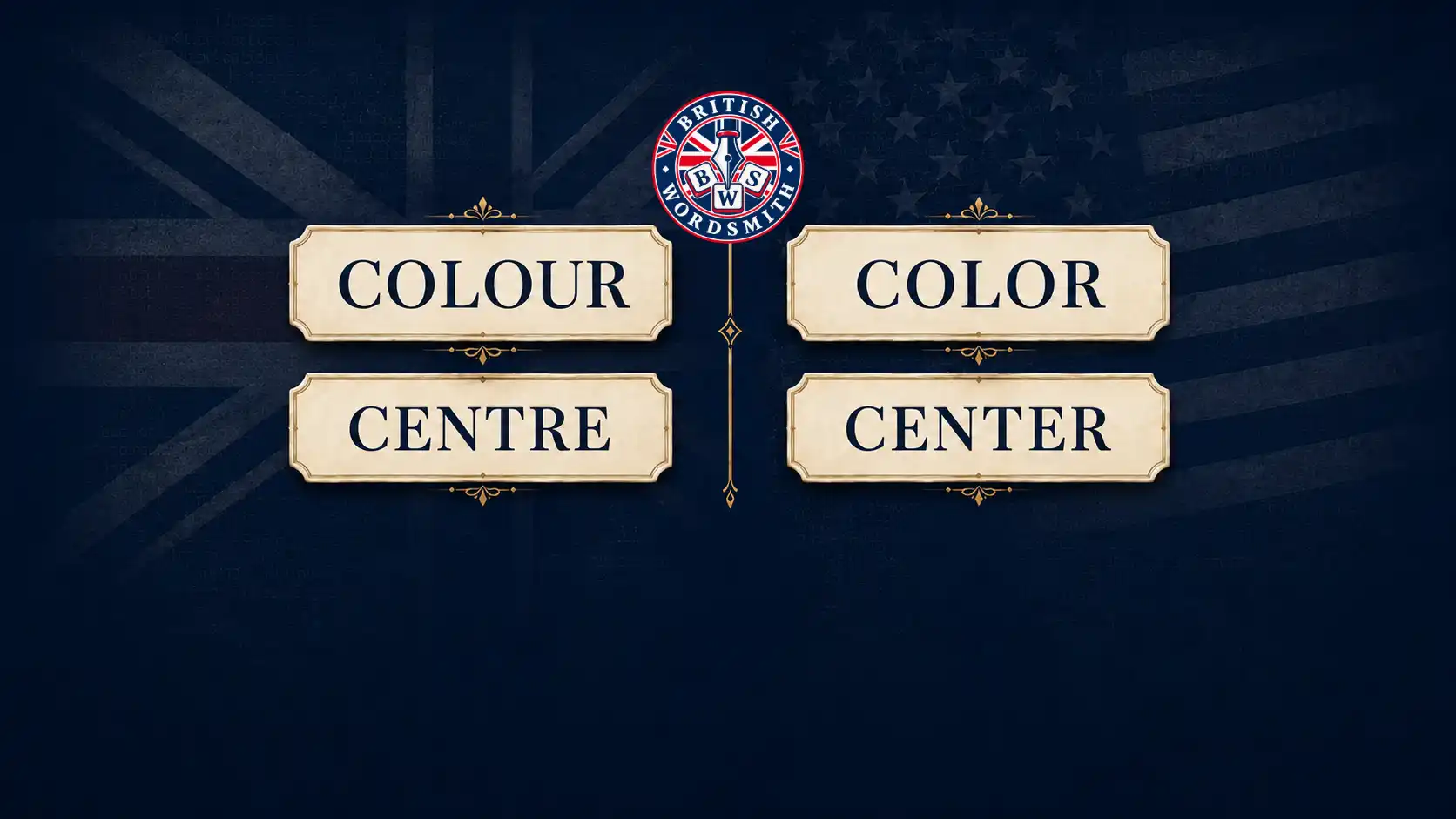
British and American English share the same foundations, but they do not always spell words in the same way. Colour becomes color, centre becomes center and travelled may lose one of its letters.
These differences rarely cause confusion, but they matter when you are writing for a particular audience, solving a crossword or checking whether a word belongs in a British word game.
This practical guide explains the most common spelling differences, the exceptions worth remembering and several cases where the rule is less straightforward than it first appears.
Why did British and American spelling diverge?
English spelling was not completely standardised when British settlers carried the language to North America. Different spellings circulated on both sides of the Atlantic, and dictionaries gradually helped establish national conventions.
American lexicographer Noah Webster promoted a number of shorter or more phonetic spellings during the late eighteenth and early nineteenth centuries. His dictionaries helped forms such as color, center and defense become standard in the United States.
Not every American spelling was invented by Webster. Many had appeared in English before his time. His influence came from selecting, promoting and standardising particular forms.
British dictionaries and publishers generally retained alternatives such as colour, centre and defence. Over time, the two written varieties developed recognisable spelling conventions of their own.
Common British and American spellings
| British English | American English | Pattern |
|---|---|---|
| colour | color | -our / -or |
| honour | honor | -our / -or |
| centre | center | -re / -er |
| theatre | theater | -re / -er |
| travelled | traveled | doubled / single l |
| jewellery | jewelry | differing letter groups |
| defence | defense | -ce / -se |
| licence | license | noun spelling |
| cheque | check | distinct form |
| programme | program | shortened form |
| tyre | tire | distinct form |
| grey | gray | differing vowel |
These are conventions rather than rules governing every word. For example, British English uses honour but not tourning, while American English uses color but retains glamour in many contexts.
The safest approach is to learn the common patterns while checking unfamiliar words individually.
Words ending in -our and -or
One of the most recognisable differences is the British -our ending and its shorter American -or equivalent.
Common examples include:
- colour and color
- favour and favor
- flavour and flavor
- humour and humor
- labour and labor
- neighbour and neighbor
However, the pattern is not universal. Words such as actor, doctor, governor and visitor end in -or in both varieties.
Glamour is also widely used in American English, although glamor is an accepted American alternative.
Centre or center?
A number of British words ending in -re reverse their final two letters in American English:
- centre and center
- fibre and fiber
- litre and liter
- metre and meter
- theatre and theater
There are important exceptions. Acre, mediocre and massacre retain their -re endings in American English.
Meter also has a special British use: a metre is a unit of length, while a meter is a measuring device, such as a parking meter.
Organise or organize?
The difference between -ise and -ize is frequently oversimplified.
Many British publishers and organisations prefer:
- organise
- recognise
- realise
- specialise
American English normally uses organize, recognize, realize and specialize.
However, -ize is not exclusively American. Oxford spelling traditionally favours -ize for many words with Greek-derived endings, so organize and recognize can also be correct British spellings.
Some words must always end in -ise because the ending is part of the word rather than the Greek suffix. These include:
- advertise
- advise
- arise
- comprise
- exercise
- promise
- surprise
British Wordsmith generally uses -ise for consistency with familiar modern UK usage. The important principle is to choose an appropriate house style and apply it consistently.
Did you know?
Loading facts…
Travelling or traveling?
British English often doubles a final l before adding a suffix, even when the final syllable is not stressed:
- travelled and traveled
- travelling and traveling
- cancelled and canceled
- counselling and counseling
- jeweller and jeweler
American English normally uses a single l in these examples.
Both varieties generally double the consonant when the final syllable is stressed, as in controlled and compelling.
The difference does not affect every word ending in l. Parallel, for example, becomes paralleled in both British and American English.
Licence or license?
British English distinguishes between the noun licence and the verb license:
- You need a driving licence.
- The authority will license the premises.
American English normally uses license for both the noun and the verb.
The same British distinction appears in advice and advise, although their pronunciations also differ.
Practice or practise?
British English usually uses practice as the noun and practise as the verb:
- Regular practice improves your spelling.
- She practises the crossword every morning.
American English uses practice for both:
- Regular practice improves your spelling.
- She practices the crossword every morning.
A useful test is to substitute advice or advise. If advice fits grammatically, use practice. If advise fits, the British spelling is practise.
Programme or program?
In British English, programme is normally used for television, radio, events and planned activities:
- a television programme
- a theatre programme
- a training programme
Program is generally reserved for computing:
- a computer program
- a programming language
American English uses program in all these contexts.
Defence, offence and pretence
British English uses -ce in several nouns that American English spells with -se:
- defence and defense
- offence and offense
- pretence and pretense
Related words may use an s in both varieties. British English therefore has defence but defensive, and offence but offensive.
Cheque, tyre and other distinctive forms
Some differences do not fit one broad pattern:
| British English | American English |
|---|---|
| cheque | check |
| tyre | tire |
| kerb | curb |
| mould | mold |
| plough | plow |
| sceptical | skeptical |
| aluminium | aluminum |
| jewellery | jewelry |
| pyjamas | pajamas |
| cosy | cozy |
Context can complicate matters. British English uses kerb for the raised edge of a pavement, but curb when referring to restraint: a kerb beside the road, but a curb on spending.
British English uses cheque for the written payment instruction, while check remains correct when something is inspected or verified.
Grey or gray?
Grey is the more common spelling in British English, while gray is preferred in American English.
Both forms have existed for centuries, and both are understood internationally. Proper names must retain their official spelling, as in Grey Goose, Gray’s Anatomy and Earl Grey tea.
Does British spelling apply throughout the Commonwealth?
Not uniformly.
Australian and New Zealand English generally follow many British conventions, including colour and centre. Canadian English mixes British and American patterns: colour and centre are common, while tire and organize may also appear.
Regional publications, schools and organisations may adopt their own style guides. A spelling can therefore be correct English without being the preferred form for a particular audience.
Which spelling should you use?
Choose the variety expected by your readers and remain consistent.
Use British English when writing primarily for readers in the United Kingdom or when a publication specifically requires it. Use American English when addressing a US audience or following an American house style.
Do not switch between colour and color, or organise and organize, without a reason. Consistency makes writing appear deliberate and professionally edited.
Proper names should keep their official spelling. A British writer should still write Pearl Harbor, while an American writer should retain the spelling of the UK Ministry of Defence.
British spelling in word games
Crosswords, anagrams and letter games may accept different words depending on their chosen dictionary or competition rules. A British puzzle might require colour, while an American puzzle expects color.
When the number of squares matters, the spelling difference can change the answer completely.
British Wordsmith concentrates on British English vocabulary and spelling. You can explore possible answers using the Crossword Solver, rearrange available letters with the Word Descrambler or browse words by length with the Word List Explorer.
Individual games may still use their own approved dictionaries, so always check the rules when playing competitively.
The short answer
British and American spellings are usually different conventions rather than examples of one country being right and the other wrong.
Colour, centre and travelled are standard British forms. Color, center and traveled are standard American forms. The correct choice depends on the audience, context and style guide.
For British writing, use familiar UK conventions consistently—and remember that even British English occasionally leaves room for more than one correct answer.