Common Crossword Abbreviations: A British Solver’s Guide
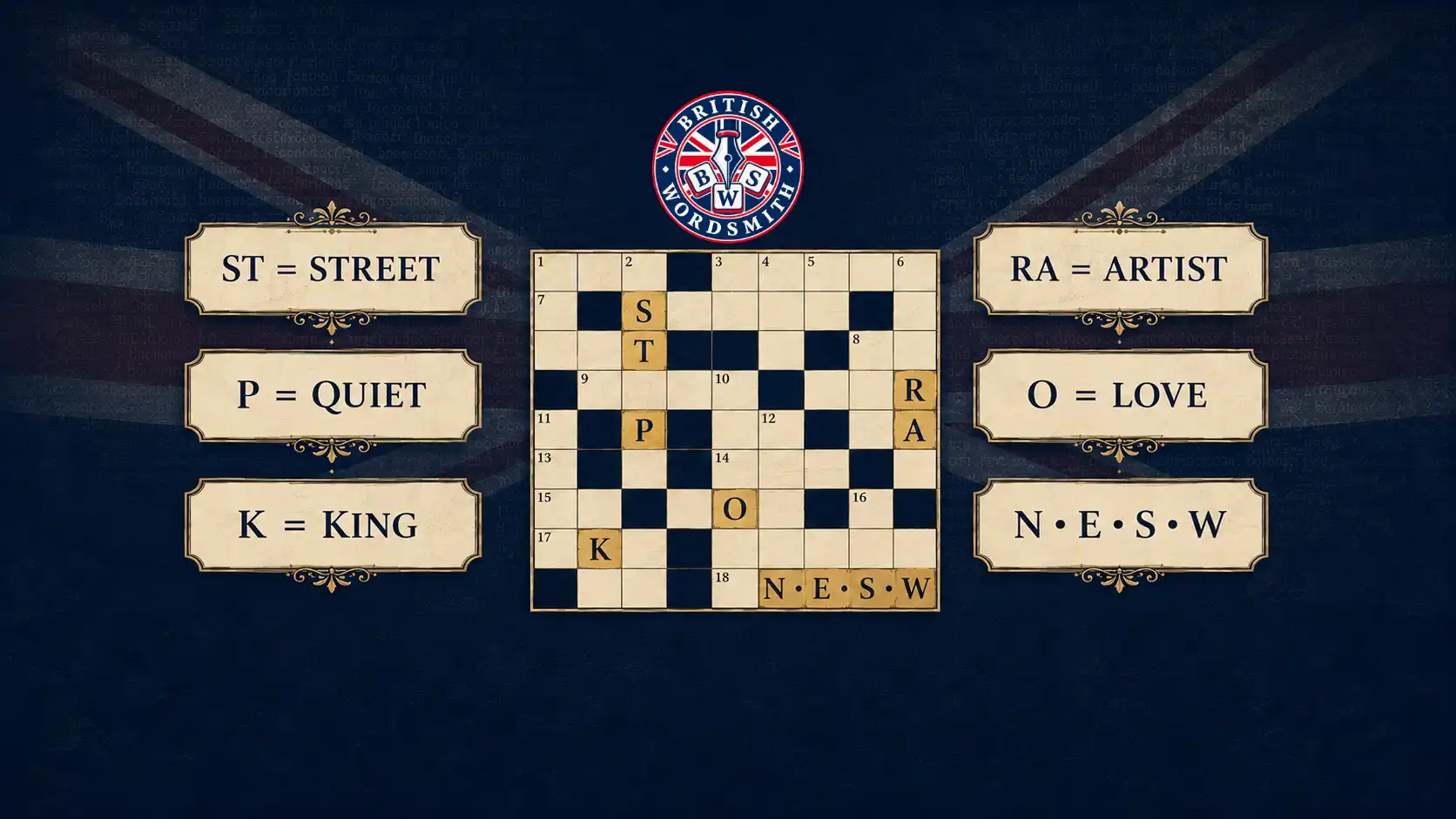
Crossword setters have a language of their own. A king may become K, a street can shrink to ST and nothing is often represented by O.
These abbreviations allow setters to compress complicated wordplay into short clues. Unfortunately, they can also leave new solvers wondering why an artist has suddenly become RA or why quiet means P.
This guide explains many of the abbreviations commonly found in British quick and cryptic crosswords, along with the conventions behind them.
Why do crosswords use so many abbreviations?
Every cryptic clue normally contains two routes to the answer:
- a definition
- a piece of wordplay
The wordplay may involve an anagram, hidden answer, reversal, deletion, selection of letters or a combination of several devices.
Abbreviations provide compact building blocks. If a setter needs the letter R, the clue might mention right, river, road or king. Solvers must decide which interpretation fits the surrounding wordplay and the required answer length.
There is no single compulsory list used by every crossword. Setters draw upon dictionaries, reference books, common notation, titles, organisations, scientific symbols and long-established crossword conventions.
Essential crossword abbreviations
These are among the most useful abbreviations for new solvers to recognise.
| Clue word | Possible abbreviation |
|---|---|
| about | C, CA, RE |
| book | B |
| cold | C |
| company | CO |
| day | D |
| doctor | DR, GP, MO |
| east | E |
| energy | E |
| good | G |
| hot | H |
| large | L |
| left | L |
| learner | L |
| love | O |
| new | N |
| north | N |
| nothing | O |
| old | O |
| operation | OP |
| page | P |
| quiet | P |
| right | R |
| river | R |
| road | RD |
| small | S |
| south | S |
| street | ST |
| time | T |
| west | W |
A clue does not always announce that an abbreviation is being used. The setter expects the shortened form to be familiar or supported by a recognised reference.
Directions and positions
Compass directions provide some of the most common single-letter components:
| Direction | Abbreviation |
|---|---|
| north | N |
| south | S |
| east | E |
| west | W |
| north-east | NE |
| north-west | NW |
| south-east | SE |
| south-west | SW |
Left and right normally become L and R.
These letters may also be indicated through other contexts. A bridge player, for example, may be N, E, S or W because the four players are traditionally identified by compass position.
Words such as eastern, western or northerly might indicate the same letters, but setters are free to vary their language.
Roads, streets and places
Postal addresses and maps supply several convenient abbreviations:
| Clue word | Possible abbreviation |
|---|---|
| avenue | AVE |
| drive | DR |
| lane | LN |
| mountain | MT |
| place | PL |
| road | RD |
| square | SQ |
| street | ST |
| terrace | TER |
Street is particularly common because ST combines easily with other material.
For example:
Street artist produces beginning (5)
The wordplay joins ST, meaning street, to ART, meaning artist’s work:
ST + ART = START
The definition is beginning.
Not every setter would phrase the clue in exactly this way, but the construction demonstrates how a familiar abbreviation can form part of a larger answer.
People, professions and titles
Crosswords frequently reduce occupations, qualifications and titles to their initials.
| Clue word | Possible abbreviation |
|---|---|
| accountant | CA |
| artist | RA |
| bishop | B |
| detective | DI, CID |
| doctor | DR, GP, MO |
| engineer | CE, RE |
| father | PA |
| king | K, R |
| knight | N |
| member of Parliament | MP |
| queen | Q, R |
| sailor | AB |
| soldier | GI, OR |
| university graduate | BA, MA, BSc |
RA refers to a Royal Academician and therefore frequently represents an artist.
RE may stand for the Royal Engineers, while CE can represent a civil engineer. Context determines whether the setter intends a profession, institution or something else entirely.
King or queen may be represented by R because the Latin words rex and regina both begin with that letter. Chess notation also supplies K for king, Q for queen, B for bishop, N for knight and R for rook.
Knight uses N because K is already occupied by the king.
Chess abbreviations
Setters often describe chess pieces as men, pieces or figures on a board.
| Chess piece | Abbreviation |
|---|---|
| king | K |
| queen | Q |
| bishop | B |
| knight | N |
| rook | R |
| pawn | P |
Castle may indicate R because a rook is sometimes called a castle.
Board can also suggest chess more generally, so a phrase such as man on board may point towards one of these letters rather than a passenger on a ship.
Time and measurement
Units of time, length and weight provide another large family of abbreviations.
| Clue word | Possible abbreviation |
|---|---|
| second | S |
| minute | M |
| hour | H, HR |
| day | D |
| week | W, WK |
| month | M |
| year | Y, YR |
| time | T |
| metre | M |
| kilometre | KM |
| gram | G |
| kilogram | KG |
| litre | L |
The same letter may have several legitimate meanings. M could represent a minute, month, metre, male, married or the Roman numeral for one thousand.
This ambiguity is deliberate. The crossing letters and the remainder of the clue reveal which meaning is required.
Did you know?
Loading facts…
Roman numerals
Roman numerals appear constantly in crosswords because they turn ordinary number words into useful letters.
| Number | Roman numeral |
|---|---|
| 1 | I |
| 5 | V |
| 10 | X |
| 50 | L |
| 100 | C |
| 500 | D |
| 1,000 | M |
A clue mentioning fifty may therefore contribute L, while a hundred could become C.
Setters sometimes use broader descriptions such as century for C, millennium for M or five in Rome for V.
Roman numerals can also appear in combinations. Six may be VI, fifteen may be XV and nineteen may become XIX.
Music and volume
Musical notation supplies several abbreviations that look mysterious until they become familiar.
| Clue word | Musical abbreviation |
|---|---|
| quiet, softly | P |
| very quietly | PP |
| loud | F |
| very loudly | FF |
| medium, moderately | M |
| note | A, B, C, D, E, F or G |
| note of scale | DO, RE, MI, FA, SOL, LA, TI |
P comes from the Italian piano, meaning soft, while F comes from forte, meaning loud. Their doubled forms, PP and FF, intensify the instruction.
A clue containing quietly may therefore require P rather than a synonym such as silently.
For example:
Quietly, organ finds fruit (4)
P, meaning quietly, is followed by EAR, an organ:
P + EAR = PEAR
The definition is fruit.
Education and qualifications
Academic degrees are useful because they supply compact groups of letters:
| Clue word | Possible abbreviation |
|---|---|
| graduate | BA, MA |
| bachelor | BA, BSc |
| master | MA, MSc |
| doctor | PhD, DPhil |
| university | U |
| university initially | UNI |
| student or learner | L |
Master can also indicate M, a schoolmaster or the title MR, depending upon the construction.
As always, the answer length matters. A two-letter gap might favour BA, while a single required letter could suggest M.
Religion and the Church
British crosswords often draw upon religious abbreviations and biblical divisions.
| Clue word | Possible abbreviation |
|---|---|
| Church of England | CE |
| Roman Catholic | RC |
| religious education | RE |
| Old Testament | OT |
| New Testament | NT |
| book | B |
| saint | ST |
| see | V |
| church | CH |
Saint and street can both produce ST, giving setters another convenient ambiguity.
Church may indicate CH as a written abbreviation, CE as the Church of England, RC as Roman Catholic or even KIRK in a Scottish context. The clue and crossing letters decide the issue.
Organisations and institutions
Well-known initials frequently appear without further explanation.
| Clue word | Possible abbreviation |
|---|---|
| broadcasting corporation | BBC |
| health service | NHS |
| international organisation | UN |
| European union | EU |
| alliance | NATO |
| intelligence service | MI5, MI6 |
| police force | CID |
| Royal Academy | RA |
| Royal Engineers | RE |
| Order of Merit | OM |
Setters may refer to an organisation indirectly. Broadcaster might suggest BBC, while service could indicate NHS.
Do not assume every institutional reference is an abbreviation. It may instead provide a word, initial letter or piece of general knowledge.
Science and chemical symbols
Chemical symbols are irresistible to crossword setters because ordinary words can disguise them naturally.
| Clue word | Symbol |
|---|---|
| gold | AU |
| silver | AG |
| copper | CU |
| iron | FE |
| lead | PB |
| tin | SN |
| oxygen | O |
| nitrogen | N |
| hydrogen | H |
| carbon | C |
| helium | HE |
| sodium | NA |
| potassium | K |
Capitalisation is often removed in crossword clues, so gold may quietly indicate AU without looking like a scientific reference.
Element can serve as an indicator that a chemical symbol is required, although an experienced setter may simply use the element’s name.
Politics and honours
Political parties, parliamentary terms and honours provide more crossword shorthand.
| Clue word | Possible abbreviation |
|---|---|
| Conservative | C, CON |
| Labour | LAB |
| Liberal | L, LIB |
| member of Parliament | MP |
| prime minister | PM |
| government | GOV |
| Order of the British Empire | OBE |
| Member of the Order of the British Empire | MBE |
| knight | K, KT |
| Order of Merit | OM |
Political abbreviations can change over time or vary between publications. Older puzzles may use forms that feel less familiar today.
Honours such as OBE and MBE are particularly useful because they create letter combinations that occur naturally inside longer answers.
Everyday crossword shorthand
Some abbreviations have become crossword staples simply because they are so useful.
| Clue word | Possible abbreviation |
|---|---|
| article | A, AN, THE |
| about | C, CA, RE |
| company | CO |
| current | I |
| energy | E |
| female | F |
| good | G |
| large | L |
| love | O |
| male | M |
| married | M |
| new | N |
| old | O |
| operation | OP |
| page | P |
| recipe | R |
| small | S |
| temperature | T |
| versus | V |
| volume | V, VOL |
Love commonly becomes O because a zero score in tennis is called love. Nothing, zero, ring, circle, duck and egg may also lead to O.
Company and operation can create a complete word together:
CO + OP = COOP
A setter might therefore build a clue around a company, an operation and a henhouse.
Does every abbreviated word contain an indicator?
No.
An anagram normally requires wording that signals rearrangement. A hidden answer usually has language suggesting containment. A standard abbreviation, however, may appear without an explicit abbreviation indicator.
Setters generally expect the shortened form to be accepted usage or a familiar crossword convention.
That does not mean anything goes. A fair clue should give the solver a reasonable route to the answer, even if that route only becomes obvious afterwards.
How do you learn crossword abbreviations?
Do not attempt to memorise hundreds of entries at once.
Start with the recurring essentials:
- compass directions
- left and right
- old and new
- large and small
- musical P and F
- chess pieces
- Roman numerals
- common titles and qualifications
- familiar organisations
- chemical symbols
When an unfamiliar abbreviation appears, write it down with the clue that used it. Context makes it much easier to remember than an isolated list.
Regular solving gradually turns strange conventions into familiar ones. Before long, artist suggests RA, quietly suggests P and love suggests O without conscious effort.
Using crossing letters
An abbreviation rarely solves a clue by itself. It usually supplies one component of a larger construction.
Enter confirmed letters and question marks into the British Wordsmith Crossword Solver to find words matching the pattern. You can then return to the clue and test whether the proposed answer explains both the definition and the wordplay.
A matching word is evidence, not proof. The best answer must account for every important part of the clue.
A useful language, not a secret code
Crossword abbreviations can initially make cryptic clues appear unfair. In reality, most setters reuse a relatively familiar collection of letters, symbols and shortened forms.
Learn the common ones, pay attention to crossing letters and remain suspicious of every innocent-looking word. A street may be ST, an artist may be RA and a quiet king could be nothing more than P followed by R.
Once that language becomes familiar, cryptic clues stop looking like riddles written by a secret society—and start revealing how cleverly they were constructed.